Skin Care
Sunscreen Every Day, No Exceptions
Why daily SPF is the single most important anti-aging step, how to choose the right sunscreen, and the application mistakes that leave you unprotected.
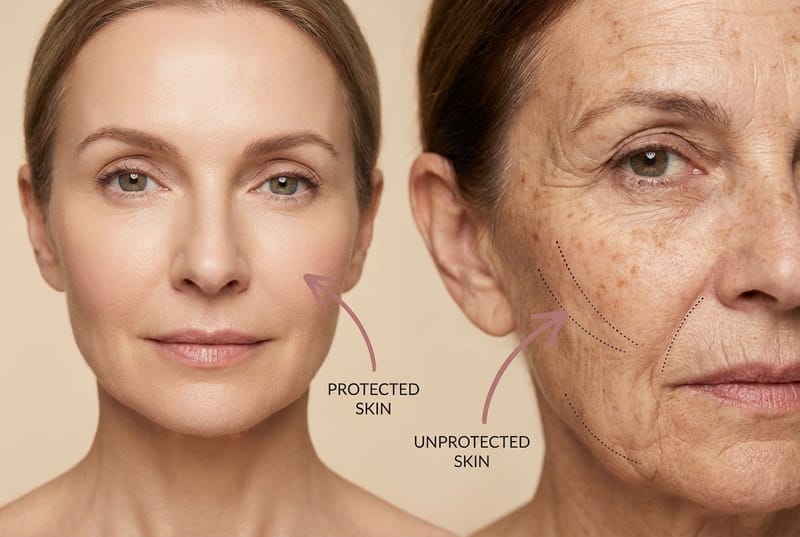
If you could use only one skincare product for the rest of your life, every dermatologist would tell you the same thing: choose sunscreen. UV radiation is responsible for up to 80 percent of visible skin aging, including wrinkles, dark spots, loss of elasticity, and uneven texture. Sunscreen is not a bonus step. It is the single most important thing you can do for the long-term health and appearance of your skin.
How UV Damages Skin
Ultraviolet radiation comes in two wavelengths that matter for skin: UVA and UVB. UVB rays are shorter and cause sunburn. UVA rays are longer, penetrate deeper into the dermis, and break down collagen and elastin fibers over time. UVA damage is cumulative and largely invisible until years later when it manifests as wrinkles, sagging, and discoloration.
UV exposure also triggers excess melanin production, leading to dark spots and uneven tone. It suppresses the skin's immune function, impairing its ability to repair damage. And in the most serious cases, it causes DNA mutations that can lead to skin cancer. All of this is preventable with consistent sun protection.
SPF Basics
SPF stands for Sun Protection Factor and measures how much UVB radiation is blocked. SPF 30 blocks approximately 97 percent of UVB rays. SPF 50 blocks about 98 percent. The difference between SPF 30 and higher numbers is marginal in practice, so SPF 30 is the recommended minimum for daily use.
SPF does not measure UVA protection. For UVA coverage, look for the terms broad spectrum, PA+++ or PA++++, or the UVA circle logo depending on your region. Any sunscreen you use daily should provide both UVA and UVB protection.
Chemical vs Mineral
Chemical sunscreens absorb UV rays and convert them to heat. They tend to be lightweight, invisible on the skin, and comfortable under makeup. Common chemical filters include avobenzone, homosalate, and octisalate. Some people with sensitive or reactive skin find chemical filters irritating.
Mineral sunscreens sit on top of the skin and physically reflect UV rays. The two mineral filters are zinc oxide and titanium dioxide. They are gentler on sensitive skin and start working immediately upon application, with no waiting period. Modern mineral formulas have improved significantly and are far less chalky than older versions.
How to Apply Properly
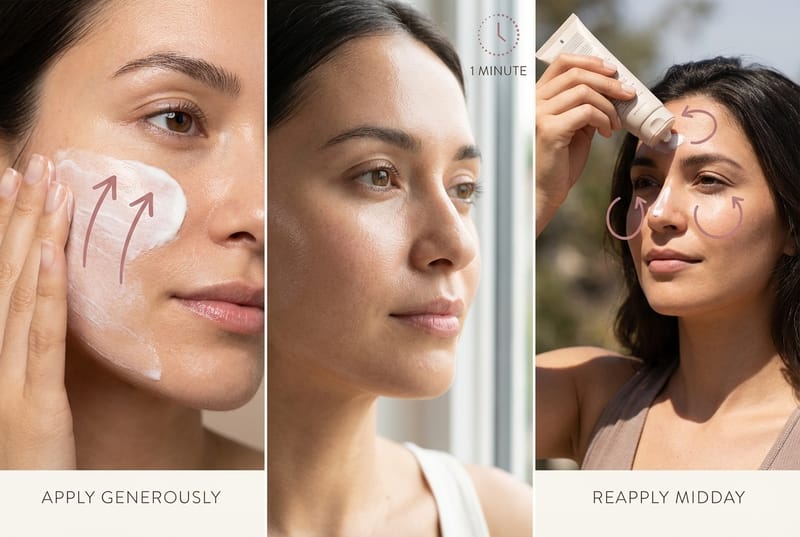
- Use enough. Most people apply far too little sunscreen. You need about a quarter teaspoon for the face alone, roughly a two-finger length of product.
- Apply to dry skin. Sunscreen goes on after your moisturizer has absorbed and before makeup. Give it a minute to set before applying anything on top.
- Reapply every two hours. This is the part most people skip, but sunscreen degrades with UV exposure and physical activity. If you are outdoors, reapply every two hours. If you are mostly indoors, reapplication at midday is reasonable.
Making It Effortless
- Choose a sunscreen you enjoy wearing. If the texture, finish, or scent bothers you, you will skip it. The best sunscreen is the one you use every day.
- Keep a sunscreen at your desk, in your bag, and in your bathroom. Accessibility removes excuses.
- Tinted sunscreens do double duty as light coverage and sun protection, simplifying your morning routine.
Face yoga with Yasmine helps repair the effects of past sun damage by boosting circulation, which supports collagen repair and cell turnover. Combined with daily sunscreen, the one-two approach of prevention and active support gives your skin its best chance at long-term health.