Skin Care
AI Skin Analysis, Explained: How One Selfie Becomes a Skin Report
How AI skin analysis works in plain language: what a model sees in your selfie, what the metrics mean, the honest limits, and privacy questions to ask.

Point a phone camera at your face, tap a button, and a few seconds later you have a skin report: an appearance age, a hydration score, notes on texture and radiance. Depending on how much you trust the technology, that can feel like magic or like guesswork. The reality is neither. AI skin analysis is a well-understood process with real strengths and real limits, and knowing both makes the results far more useful.
This article walks through what actually happens between the selfie and the report: what a model looks at, how it learned to look, what the common metrics mean, where the technology honestly falls short, and what to ask about your photos before you upload them.
What a Model Actually Sees in a Selfie
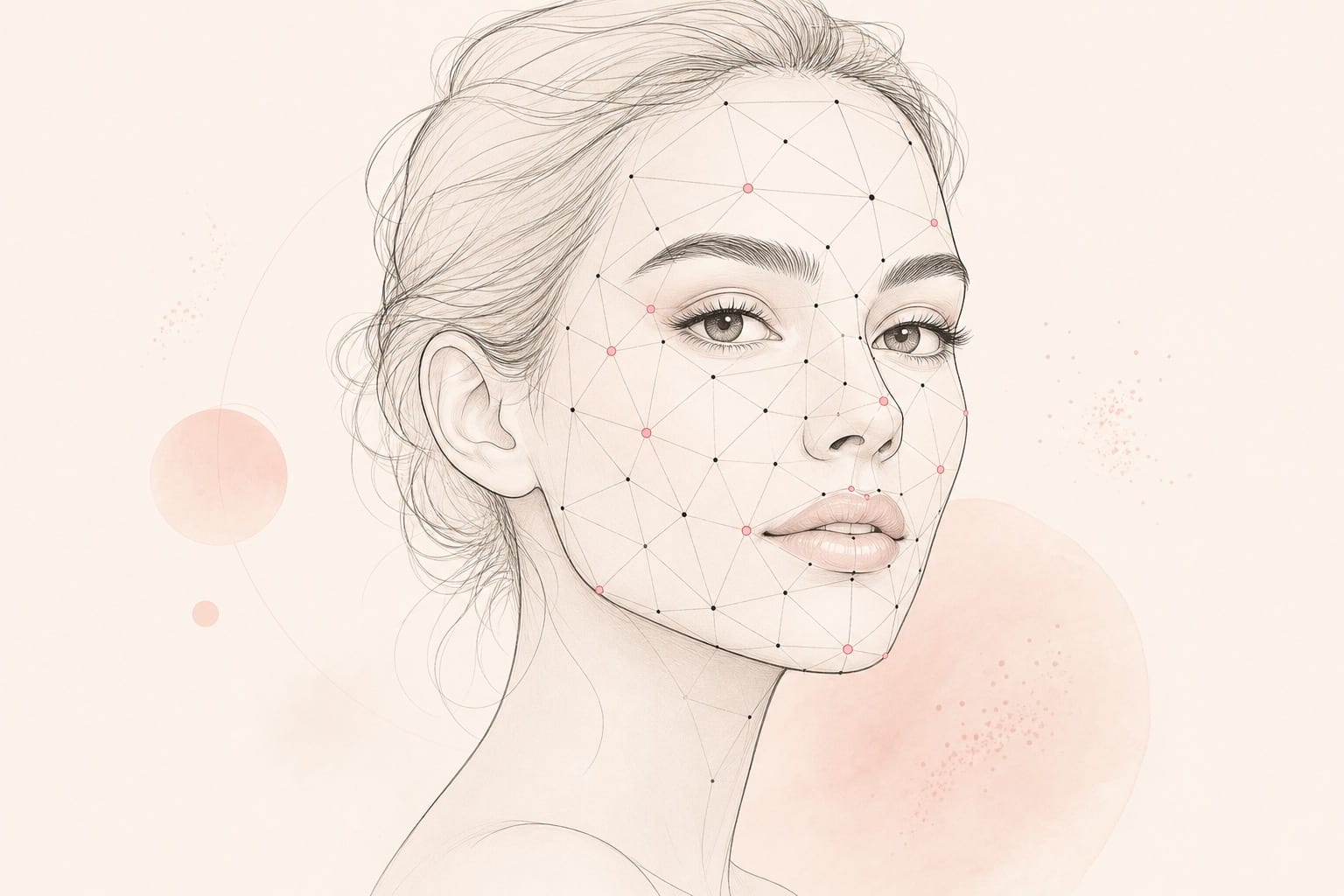
To a computer, your selfie is a grid of millions of colored dots. An AI skin analysis model scans that grid for the same patterns humans notice, just far more systematically. It examines texture: how uniform the skin surface appears, where pores are more visible, and where roughness or bumpiness interrupts smoother areas. Because it processes the whole face at once, it catches variation that a quick glance in the mirror smooths over.
It measures tone evenness by comparing color across regions of the face. Patches of redness, darker areas, and uneven pigmentation all show up as color variation the model can map with precision. It traces visible lines — the fine creasing around the eyes, across the forehead, and around the mouth — by detecting the characteristic patterns of shadow and highlight that lines create.
It also reads shine and light reflection. Smooth, well-moisturized skin reflects light differently than dry or rough skin, and oily areas produce their own distinct highlights, so the way light bounces off your face carries real information. None of this involves the model understanding skin the way a person does. It is pattern detection, performed at a level of consistency and detail the human eye cannot match.
How the Model Learned to Look
AI skin analysis models are built through a process called supervised learning. Developers assemble large collections of facial photos, each labeled with relevant information — the person's actual age, or assessments of skin qualities made by trained human graders. The model processes these examples over and over, gradually adjusting its internal settings until its own outputs line up with the labels.
After enough examples, the model has internalized statistical patterns: which combinations of texture, tone, and line placement tend to appear in skin graded as more or less hydrated, more or less firm, older or younger looking. When you take a selfie, it compares what it sees against everything it learned and produces its best estimate. There is no rulebook inside saying what a wrinkle is; there are patterns extracted from many thousands of examples.
Two things follow from this. First, a model is only as good as the photos it learned from, which is why responsible developers work to include a wide range of skin tones, ages, and lighting conditions in training. Second, the model estimates how your skin looks compared to the patterns in its training data — nothing more. That distinction matters more than any other point in this article.
The Metrics, Decoded

Most AI skin analysis tools report a similar cluster of metrics. The names vary between apps, but the underlying ideas are consistent. Here is what each one typically reflects.
- Appearance age — an estimate of how old your skin looks, based on visible lines, texture, and firmness cues. It is a statement about appearance in one photo, not about your biological age or your health.
- Hydration — an inference drawn from surface cues such as fine texture, light reflection, and visible dryness or flaking. A camera cannot measure water content directly; it reads the visual signature that hydrated skin tends to produce.
- Texture — how smooth or uneven the skin surface appears, including visible pores, roughness, and small bumps.
- Elasticity — estimated from firmness-related cues, such as how skin sits along the jawline and cheeks and how defined the facial contours appear. This is also an inference from appearance, since a photo cannot physically press on your skin the way a dermatologist's instrument can.
- Radiance — how evenly and brightly your skin reflects light, often described as glow. Dullness, uneven tone, and rough texture all pull it down.
Scores like these are most meaningful in relation to each other and to your own history, not as absolute grades. A hydration score on its own says little. A hydration score that climbs over six weeks of consistent care says a lot.
The Honest Limits
Any tool that analyzes photos inherits the limitations of photography, and it is worth being clear-eyed about what those are before you put weight on a score.
Lighting, Makeup, and Camera Quality
Harsh overhead light exaggerates shadows and can make lines look deeper than they are. Warm evening light flatters tone, while cool daylight reveals more variation. Makeup smooths visible texture and evens out color, which means a made-up selfie mostly tells the model about your makeup rather than your skin. Camera quality matters too: a soft, noisy, or heavily filtered image hides exactly the fine detail the model relies on. For results you can compare over time, scan with a clean face, in similar lighting, at a similar time of day.
It Assesses How Skin Looks, Nothing More
This is the boundary that matters most. AI skin analysis assesses how your skin looks in a photograph. It does not diagnose skin conditions, it cannot see beneath the surface, and it does not replace a dermatologist. A model might flag uneven tone, but it cannot tell you why the tone is uneven, and it should never be the reason you delay seeing a professional about something that concerns you.
The Privacy Questions Worth Asking
A skin scan requires a clear, well-lit photo of your face, and a facial photo is sensitive data by any reasonable definition. Before using any scanning app, it is fair to ask a few direct questions and expect direct answers.
- What happens to my photo after the analysis? Is it deleted, stored indefinitely, or used for something beyond my report?
- Are my photos used to train the company's models, and if so, did I explicitly agree to that rather than accept it through a buried clause?
- Can I delete my scan history and data whenever I choose, and is the deletion actually complete?
Good apps answer these questions plainly in their privacy policy. For what it is worth, Yasmine deletes photos from its servers immediately after processing; images are only kept if you explicitly opt in. Whichever tool you choose, an app that stays vague about photo handling has answered the question by not answering it.
How to Actually Use Your Results
The least useful way to treat a skin scan is as a verdict — a single number that pronounces judgment on your face. The most useful way is as a baseline plus a trend.
Your first scan sets the baseline: a structured snapshot of texture, tone, hydration cues, and visible lines at one moment, under one set of conditions. On its own it is mildly interesting. Its real value appears when you rescan under similar conditions every few weeks and watch the direction of change. Skin changes slowly, and daily mirror checks are a poor instrument for noticing gradual progress, because your eyes adapt to your own face. Consistent scans are much better at it.
Trends also keep a routine honest. If you introduce a new moisturizer, a retinoid, or a daily face yoga practice, your scan history shows whether the visible measures are actually moving. The AI face scanner in the Yasmine app is built around exactly this loop: scan, follow your routine, rescan, and adjust based on what changed rather than what you hoped would change. And if you are simply curious where you stand today, our free skin age test runs in the browser and takes about a minute.
AI skin analysis is neither magic nor a gimmick. It is a fast, consistent way to read the surface of your skin — genuinely good at spotting patterns and tracking change over time, genuinely unable to look beneath the surface or replace professional care. Use it the way it works best: as a mirror with a memory, feeding small, steady improvements into a routine you actually follow.