Wellness
Ingredients and Treatments That Help
A clear guide to the most effective hair loss treatments: what works, how it works, and what the evidence actually says about each option.
The hair loss treatment market is full of bold claims and limited evidence. For every ingredient that genuinely supports hair growth, there are dozens that have no clinical backing despite confident marketing. This article focuses on the treatments with the strongest evidence, explaining how each one works so you can make informed decisions about what to try.
Minoxidil
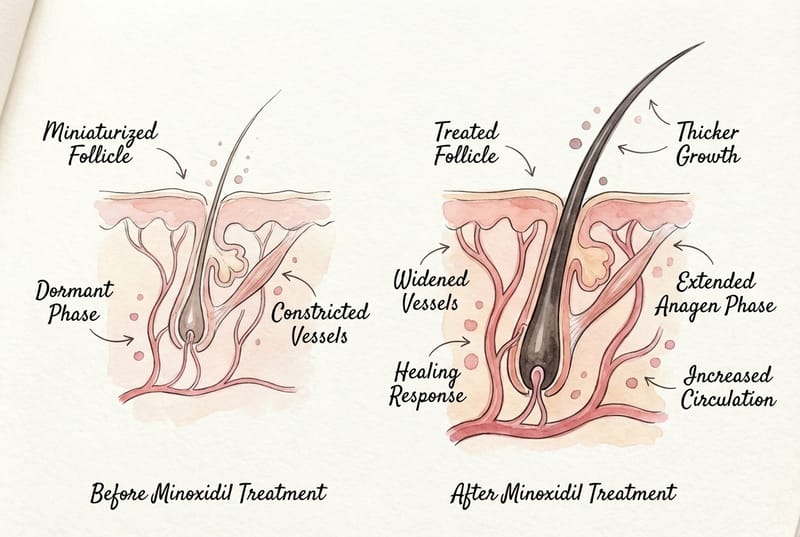
Minoxidil is the most widely available and extensively studied over-the-counter hair loss treatment. Originally developed as a blood pressure medication, it was found to stimulate hair growth as a side effect. Applied topically to the scalp, it widens blood vessels around the follicles, extends the growth phase, and can enlarge miniaturizing follicles to produce thicker hair.
Minoxidil is available at 2 and 5 percent concentrations and works for both male and female pattern hair loss. Results typically become visible after three to six months of consistent daily use. It is important to understand that minoxidil maintains the hair you regrow only as long as you continue using it. Stopping use gradually reverses the gains.
Finasteride
Finasteride is a prescription oral medication that blocks the conversion of testosterone to DHT, the hormone responsible for follicle miniaturization in pattern hair loss. It is the most effective single treatment for male pattern hair loss, reducing DHT levels in the scalp by approximately 70 percent. For men, it can halt progression and produce meaningful regrowth in many cases.
Finasteride is typically prescribed at 1 mg daily for hair loss. Side effects are uncommon but can include reduced libido and mood changes, which reverse when the medication is discontinued. It is not approved for use in women of childbearing age due to risks during pregnancy, though some dermatologists prescribe it off-label for postmenopausal women.
Rosemary Oil
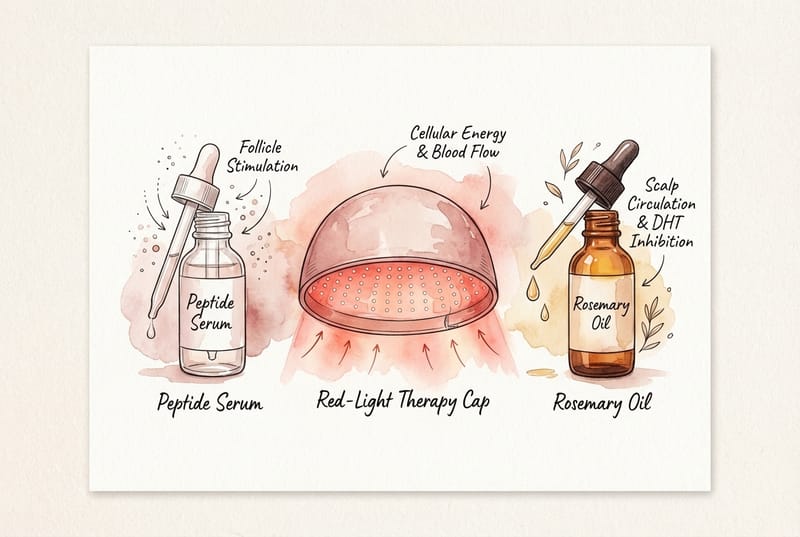
Rosemary essential oil has generated significant interest as a natural alternative to minoxidil. The mechanism is thought to involve improved scalp circulation and anti-inflammatory effects.
If you want to try rosemary oil, dilute it in a carrier oil (three to five drops per tablespoon of jojoba or coconut oil) and massage it into the scalp for several minutes before washing. Consistent daily use is necessary to see results, and as with any treatment, allow at least three months before evaluating effectiveness.
Peptides and Growth Factors
Certain peptides, including redensyl, capixyl, and various growth factor serums, have shown promise in clinical studies for supporting hair density. They work by signaling follicle stem cells and promoting the transition from the resting phase to the growth phase. These are available in specialized scalp serums and are generally well-tolerated.
While the evidence is encouraging, it is not yet as robust as the data behind minoxidil and finasteride. Peptide-based treatments are best considered as complementary additions rather than primary treatments.
Biotin
Biotin, or vitamin B7, is perhaps the most marketed hair supplement, but the evidence is nuanced. Biotin deficiency does cause hair loss, and supplementation resolves it. However, true biotin deficiency is uncommon in people with a normal diet. For those with adequate biotin levels, supplementation has not been shown to produce additional hair growth benefits.
If you suspect a deficiency, a blood test can confirm it. Otherwise, a balanced diet provides sufficient biotin for most people. Taking a biotin supplement is unlikely to cause harm, but it is also unlikely to produce the dramatic results that marketing suggests.
Red Light Therapy
Low-level laser therapy (LLLT) or red light therapy uses specific wavelengths of light to stimulate cellular activity in the scalp. Several FDA-cleared devices are available for home use, and clinical studies have shown modest improvements in hair density with consistent use. The treatment works by increasing cellular energy production in follicle cells, promoting the growth phase of the hair cycle.
- Devices range from laser caps and helmets to handheld combs. Consistent use, typically three to four times per week for 15 to 25 minutes, is required.
- Results are modest compared to minoxidil or finasteride but meaningful as an addition to a comprehensive approach.
Yasmine face yoga supports hair treatment efforts by improving the scalp circulation that helps deliver topical treatments to the follicles. The increased blood flow from consistent facial and scalp exercises creates a more receptive environment for whatever products or treatments you are using.