Wellness
Identifying Your Hair Loss Pattern
How to recognize different types of hair loss: male and female pattern, diffuse thinning, patchy loss, and what each pattern tells you about the cause.
Not all hair loss looks the same, and the pattern of your hair loss provides important clues about its cause. Recognizing your specific pattern helps you and, if needed, a medical professional determine the most effective response. This article walks you through the most common patterns and what each one typically indicates.
Male Pattern Hair Loss
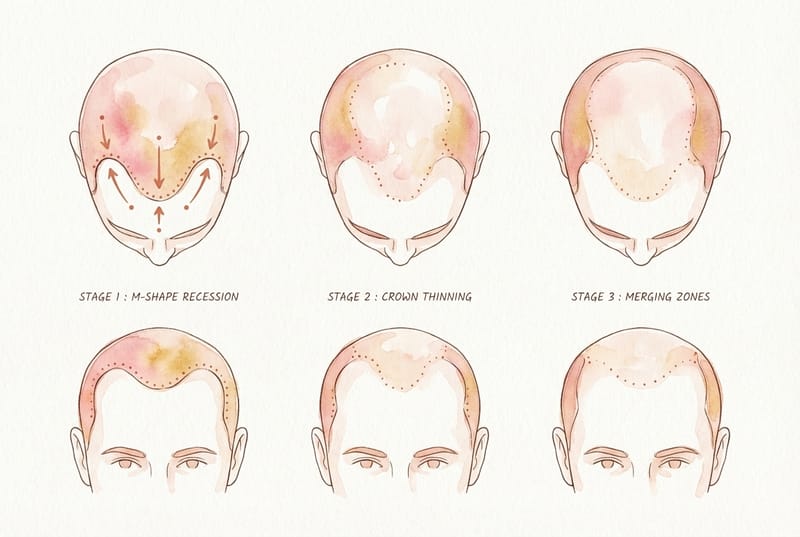
Male pattern hair loss, or androgenetic alopecia in men, follows a predictable progression. It typically begins with a receding hairline at the temples, forming an M-shape. Over time, the crown also begins to thin. In advanced stages, these areas merge, leaving hair primarily around the sides and back of the head. This pattern is driven by DHT sensitivity in the affected follicles and is the most common form of hair loss in men.
The Hamilton-Norwood scale classifies male pattern hair loss into seven stages, from minimal recession to extensive loss. Knowing your stage helps set realistic expectations for treatment outcomes, as earlier stages respond much better to intervention than advanced ones.
Female Pattern Hair Loss
Female pattern hair loss looks different from the male version. Rather than a receding hairline, women typically experience diffuse thinning across the top and crown of the scalp. The part line gradually widens, and the hair density decreases without creating completely bald areas. The Ludwig scale classifies female pattern loss into three stages based on the degree of thinning along the part.
Female pattern loss is also driven by androgen sensitivity, though hormonal factors like menopause, postpartum changes, and conditions affecting androgen levels play a more prominent role. The frontal hairline is usually preserved, which distinguishes it from male pattern loss.
Telogen Effluvium
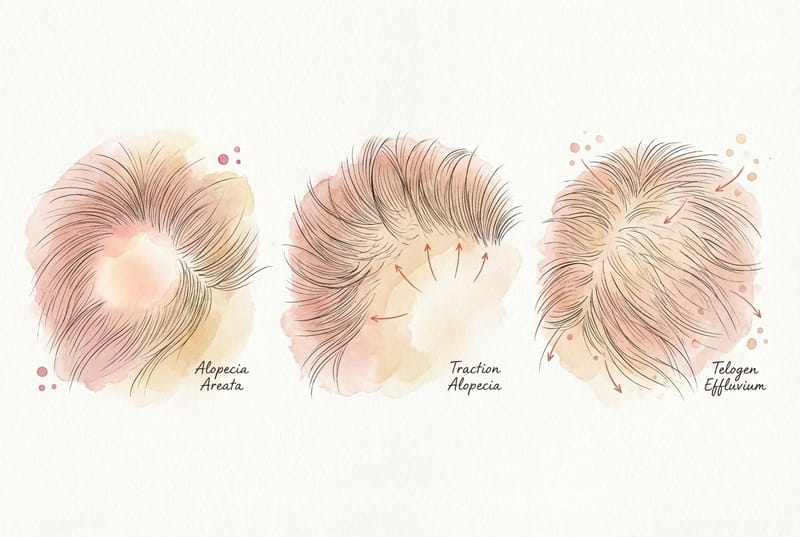
Telogen effluvium is diffuse, sudden shedding that affects the entire scalp relatively evenly. Rather than thinning in a specific pattern, you notice more hair in your brush, in the shower drain, and on your pillow. It is typically triggered by a stressful event, illness, surgery, dramatic weight loss, or hormonal change that occurred two to three months before the shedding began.
The good news about telogen effluvium is that it is almost always temporary. Once the triggering event resolves, the hair growth cycle resets and full density usually returns within six to twelve months. No specific treatment is required beyond addressing the underlying cause, though patience during the regrowth period is essential.
Alopecia Areata
Alopecia areata is an autoimmune condition that causes round, smooth patches of complete hair loss. The patches can appear anywhere on the scalp and sometimes on the body. The onset is typically sudden and can be startling. Unlike pattern loss, the follicles are not destroyed, which means regrowth is possible, though the condition can be unpredictable.
Alopecia areata requires medical evaluation and treatment. A dermatologist can confirm the diagnosis and discuss options including topical corticosteroids, JAK inhibitors, and other immunomodulating treatments.
Traction Alopecia
Traction alopecia is hair loss caused by chronic pulling or tension on the hair follicles. Tight ponytails, braids, extensions, and heavy styling repeatedly stress the follicles, which can eventually become permanently damaged. It is most noticeable along the hairline and wherever tension is greatest. Caught early, it is fully reversible by changing hairstyling habits. Caught late, the damage may be permanent.
When to Seek Professional Evaluation
- Sudden onset of significant shedding, especially if you cannot identify a clear trigger.
- Smooth, round patches of complete hair loss, which suggest alopecia areata.
- Scalp symptoms like itching, burning, scaling, or pain alongside hair loss, which may indicate infection or inflammatory conditions.
- Hair loss accompanied by other symptoms like fatigue, weight changes, or menstrual irregularities, which may point to thyroid or hormonal issues.
Yasmine face yoga exercises that target the forehead and scalp areas promote blood flow to the follicles. While this does not treat pattern hair loss on its own, consistent scalp circulation support helps maintain the health of the follicles that are still active.