Skin Care
Identifying Your Personal Triggers
A practical guide to discovering what triggers your facial redness: common culprits, how to keep a trigger journal, and the elimination approach.

Redness-prone skin reacts to triggers, and the triggers are different for everyone. One person flushes from a glass of wine while another can drink without any response. One person reacts to wind and cold while another flares in heat and humidity. Identifying your personal triggers is one of the most powerful steps you can take because avoidance is always easier than treatment.
Common Trigger Categories
While individual triggers vary, they tend to fall into predictable categories. Working through each category systematically helps you build a map of what your skin reacts to.
- Temperature extremes: hot weather, cold wind, moving between heated buildings and cold outdoor air, hot showers, and saunas.
- Food and drink: alcohol (especially red wine), spicy food, hot beverages, histamine-rich foods, and caffeine for some people.
- Skincare products: fragranced products, strong acids, alcohol-based toners, and physical exfoliants.
- Emotional triggers: stress, embarrassment, anxiety, and anger, all of which activate the sympathetic nervous system and dilate facial blood vessels.
- Environmental factors: sun exposure, wind, dry air, pollution, and indoor heating.
The Trigger Journal
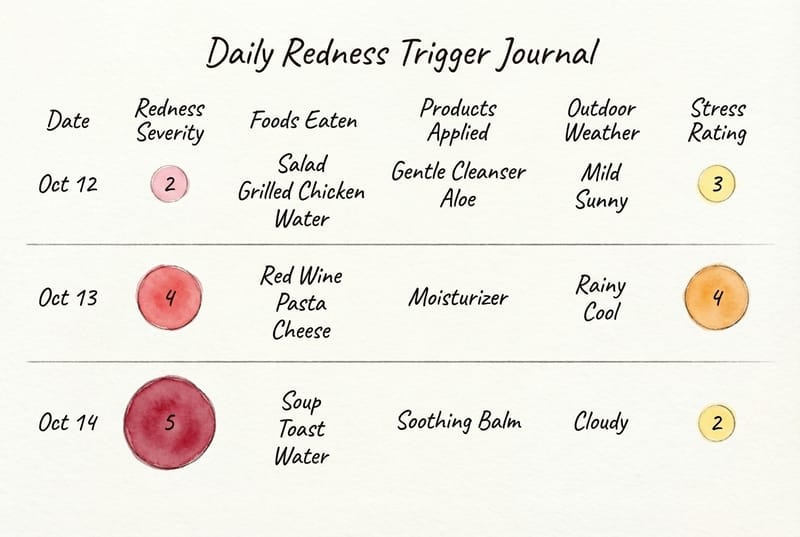
A trigger journal is the most effective tool for identifying your personal patterns. For two to four weeks, make a brief daily note of your redness level (mild, moderate, or significant) along with what you ate, what products you used, the weather, your stress level, and any notable events. Patterns usually emerge within two to three weeks.
You do not need anything elaborate. A note on your phone with the date, a redness rating, and a list of potential exposures is enough. The goal is to find correlations between specific triggers and flare-ups.
The Elimination Approach
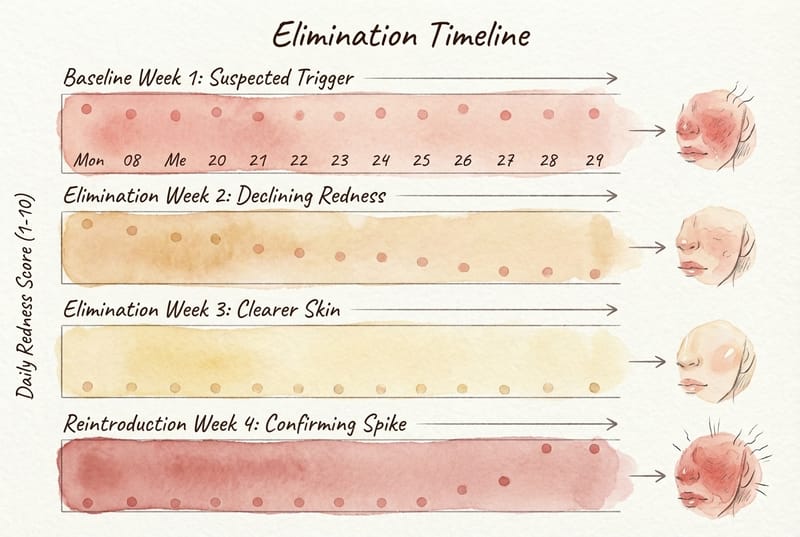
Once you suspect a trigger, confirm it by eliminating it for two weeks while keeping everything else consistent. If your redness improves, reintroduce the suspected trigger and see if the redness returns. This controlled approach gives you reliable information rather than guesses.
- Start with skincare products. These are the easiest to control. Strip back to the simplest possible routine (gentle cleanser, basic moisturizer, mineral sunscreen) and see if redness improves.
- Test dietary triggers next. Eliminate one category at a time: alcohol for two weeks, then spicy foods, then dairy. Observe your skin with each elimination.
- Address environmental triggers. Use a humidifier in dry environments, shield your face from wind and cold, and ensure indoor temperatures are moderate.
The Role of Stress
Stress is one of the most consistent redness triggers and one of the hardest to control. The sympathetic nervous system, which manages the fight-or-flight response, directly dilates facial blood vessels. Chronic stress keeps this system partially activated, creating a baseline of increased vascular tone that makes flushing more frequent and more intense.
Stress management is not just a nice-to-have for redness-prone skin. It is a treatment. Any practice that activates the parasympathetic nervous system, such as deep breathing, meditation, gentle yoga, or even a slow walk, helps counteract the vascular effects of stress.
Yasmine face yoga serves as both a trigger identification tool and a stress-management practice. The gentle, focused breathing built into each session activates the calming branch of your nervous system, directly counteracting one of the most common redness triggers.