Skin Care
Freckles and Genetic Pigmentation
When pigmentation is part of your natural makeup: understanding freckles, birthmarks, and the choice between embracing and treating them.
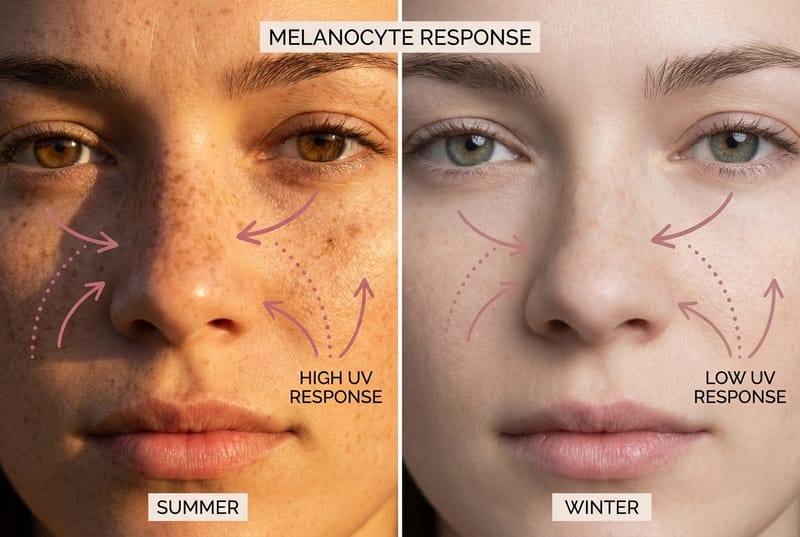
Not all pigmentation is unwanted, and not all of it needs treatment. Freckles, birthmarks, and other forms of genetic pigmentation are natural variations in how your melanocytes behave. They are part of your individual skin identity. This article explores what causes them, when they are worth monitoring, and how to think about the choice between treatment and acceptance.
How Freckles Work
Freckles, or ephelides, are small, flat spots that appear on skin that is regularly exposed to the sun. They develop because some melanocytes produce more melanin than their neighbors when triggered by UV radiation. Freckles darken in summer and fade in winter as UV exposure changes. They are most common in people with lighter skin and red or blonde hair, and they are determined almost entirely by genetics.
Freckles themselves are harmless. They are simply evidence that your melanocytes are uneven in their UV response, producing concentrated patches of pigment rather than an even tan. There is no medical reason to treat them unless you personally want to reduce their appearance.
Other Forms of Genetic Pigmentation
Beyond freckles, several other types of pigmentation have a genetic basis.
- Cafe-au-lait spots are flat, light brown marks that are present from birth or early childhood. They are typically harmless, though multiple spots can sometimes indicate an underlying condition worth evaluating.
- Dermal melanocytosis, sometimes called Mongolian spots, are blue-gray patches commonly present at birth in people with darker skin tones. They usually fade during childhood.
- Moles, or nevi, are clusters of melanocytes that form raised or flat spots. Most moles are benign, but changes in size, shape, color, or symmetry should be evaluated by a dermatologist.
The Choice to Treat or Embrace
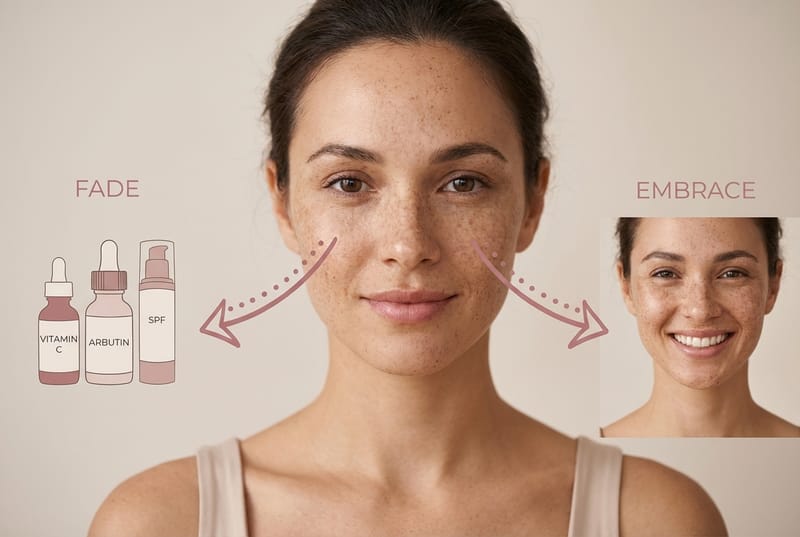
Whether to treat natural pigmentation is a deeply personal decision that has no right answer. Some people embrace their freckles and natural marks as part of their identity. Others prefer to minimize them for aesthetic reasons. Both choices are valid.
If you choose to reduce freckles or genetic spots, the same brightening ingredients used for other types of pigmentation can help: vitamin C, niacinamide, alpha arbutin, and azelaic acid. Sunscreen is essential because UV exposure will re-darken freckles as fast as any treatment can fade them.
When to Get Checked
While most genetic pigmentation is harmless, certain changes warrant professional evaluation. Any spot that is changing, whether growing, darkening asymmetrically, developing irregular borders, or changing in texture, should be examined by a dermatologist. The ABCDE rule is a useful guide: Asymmetry, Border irregularity, Color variation, Diameter larger than 6mm, and Evolution or change over time.
Yasmine face yoga supports overall skin health and circulation regardless of whether you choose to treat or embrace your natural pigmentation. The improved blood flow and lymphatic drainage benefit every skin type and tone.