Anti-Aging
Firming and Smoothing: Wrinkles and Sagging
Understand different wrinkle types, the ingredients that address them, and how face yoga supports firmer skin.
Wrinkles and loss of firmness are the two concerns people associate most strongly with aging skin, and they are deeply connected. As collagen and elastin production slows, skin loses the internal scaffolding that keeps it plump and resilient. Understanding exactly what you are looking at makes it much easier to respond with the right approach.
Three Kinds of Wrinkles
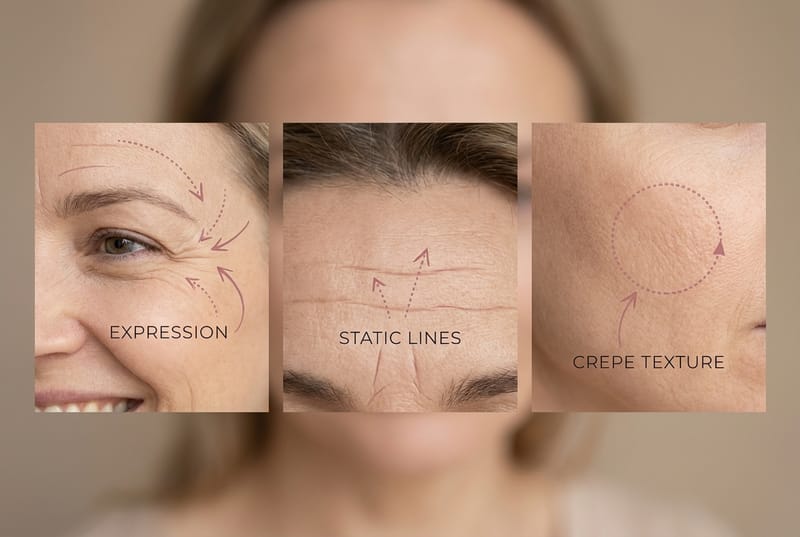
Not all wrinkles behave the same way or respond to the same care. Categorizing what you see is the first step toward addressing it effectively.
- Expression lines appear with movement, such as a smile, a squint, or a raised brow. They form earliest and are most visible in motion before becoming fixed.
- Static wrinkles remain visible even when your face is completely relaxed. They develop once collagen loss and repeated folding have etched a crease into the skin's structure.
- Crepe-like texture describes a fine, paper-thin pattern of surface lines across larger areas like the cheeks, neck, and temples, resulting from collagen thinning and moisture loss.
Ingredients That Firm and Smooth
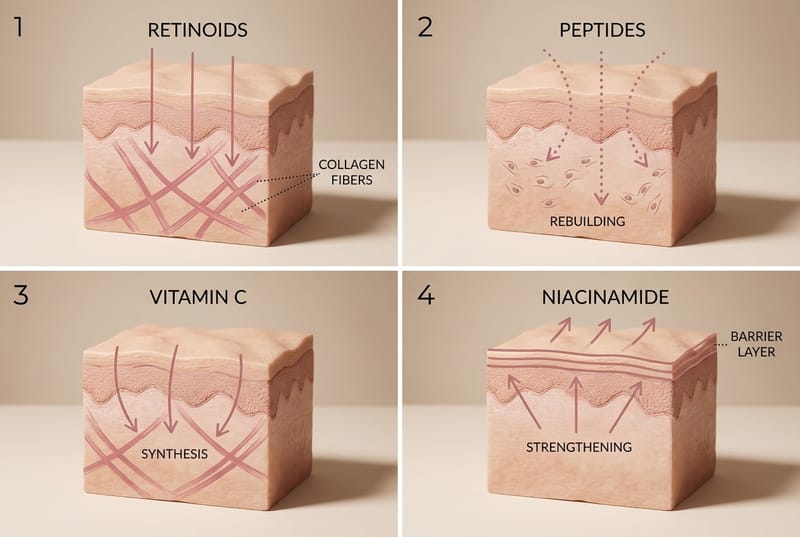
A handful of well-studied ingredients can make a measurable difference in skin firmness and fine line depth with consistent use. Each one works through a different mechanism, so combining two or more often produces better results than relying on any single ingredient alone.
- Retinoids are vitamin A derivatives that speed cell turnover and stimulate collagen production. They are among the most studied topical ingredients for visible improvement in lines and texture.
- Peptides are short chains of amino acids that signal the skin to produce more collagen. They work more slowly than retinoids but are well-tolerated by sensitive skin.
- Vitamin C is a powerful antioxidant that supports collagen synthesis and adds a brightening effect. A stable form applied in the morning works alongside sun protection.
- Niacinamide strengthens the skin barrier, reduces surface redness, and improves the appearance of enlarged pores and uneven texture.
Introducing Retinoids Safely
Retinoids deliver significant results but require a careful introduction to avoid irritation. Follow these steps to build tolerance gradually.
- Start with a low concentration. Begin with 0.025 to 0.1 percent retinol. Higher concentrations increase the chance of redness and flaking during the adjustment period.
- Buffer with moisturizer. Apply a light moisturizer first, then place a pea-sized amount of retinoid on top. This reduces initial irritation without canceling the benefit.
- Build frequency gradually. Start with one or two nights per week for the first month. Add a third night only when your skin shows no signs of sensitivity.
Face Yoga, Hydration, and Realistic Expectations
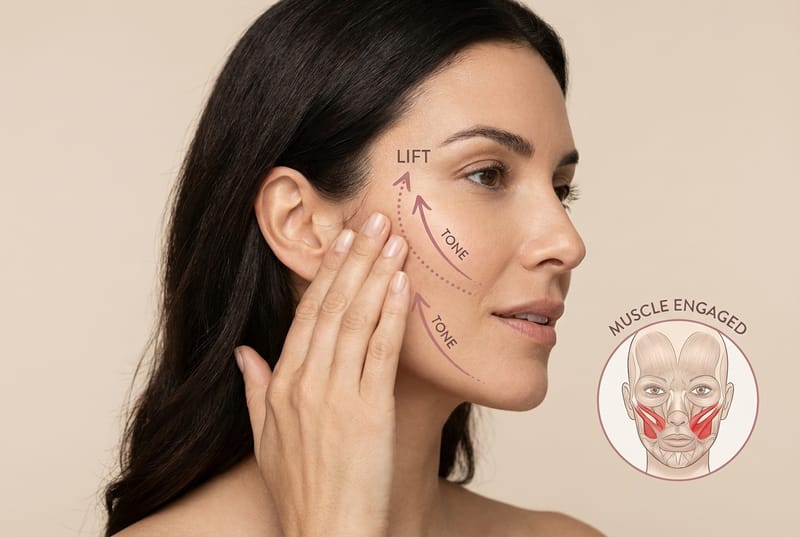
Topical ingredients work on the surface, but the muscles beneath also contribute to how firm and lifted your face looks. Yasmine face yoga exercises train the underlying muscles and improve local circulation, supporting the structural tone that keeps skin looking taut. The cheek lifts, jaw work, and forehead sequences are especially relevant for addressing sagging along the midface and jawline.
Hydration plays a quieter but equally real role. Fine lines become significantly more visible when skin is dehydrated. The realistic timeline for noticeable change from topical actives is six to twelve weeks for texture and surface lines, and three to six months for deeper improvement. Setting accurate expectations keeps consistency high, which is what drives the best results.