Anti-Aging
Discover Your Facial Aging Type
Identify which of the four facial aging patterns is most active for you so your care routine can match what your face actually needs.
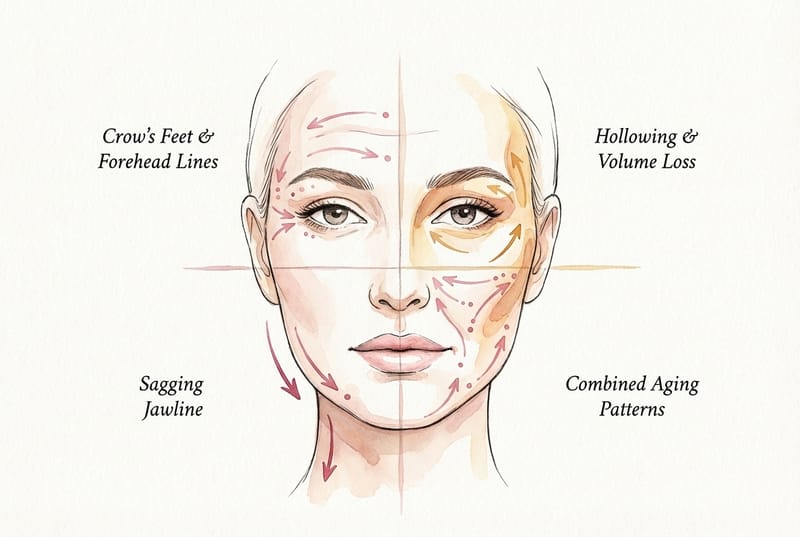
Not all faces age the same way. Two people the same age can show completely different patterns depending on genetics, muscle habits, lifestyle, and skin structure. Learning which pattern is most prominent on your own face is more useful than following generic anti-aging advice, because it points you toward the specific care that will actually make a visible difference.
Find Your Pattern: A Quick Self-Check
Before reading the type descriptions, take one to two minutes to look at your face in good lighting, ideally natural daylight, with no makeup. Try to observe with curiosity rather than judgment. These four questions are designed to point you toward your dominant pattern.
- When you look at your forehead and the area around your eyes, do you notice many fine lines even when your face is relaxed and not making any expression?
- Do your cheeks feel or look flatter than they used to, or does your face appear more angular and less full compared to photos from a few years ago?
- Does the skin along your jaw, neck, or lower cheeks feel like it has shifted downward or lost its earlier firmness, creating a heavier or softer lower face?
- Do you notice more than one of the above patterns in different zones of your face at the same time?
Type One: Fine Lines Dominant
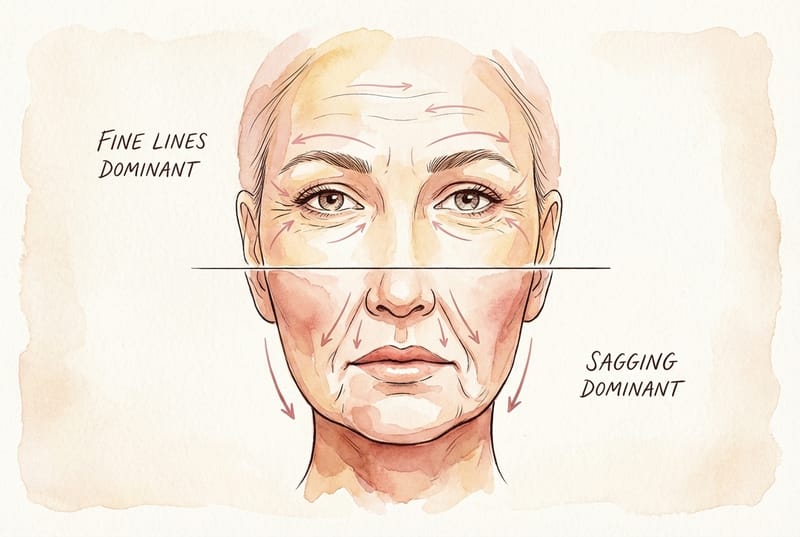
This type shows up primarily as surface-level texture change. Fine lines appear at rest, not just when the face is moving, often across the forehead, between the brows, and at the outer corners of the eyes. The overall volume and structure of the face may still look full, but the skin's surface has a finer, more creased appearance than before.
The main drivers are repetitive muscle movement, reduced moisture retention, and slower surface cell turnover. Consistent gentle movement, like face yoga exercises that soften the brow and smooth the forehead, can help retrain unconscious muscle tension.
Type Two: Volume Loss Dominant
This type centers on structural change rather than surface texture. The face looks flatter, more angular, or hollowed in areas that used to appear full and rounded, particularly the mid-cheek and the area beneath the eyes. Fine lines may be minimal, but the face has a deflated quality.
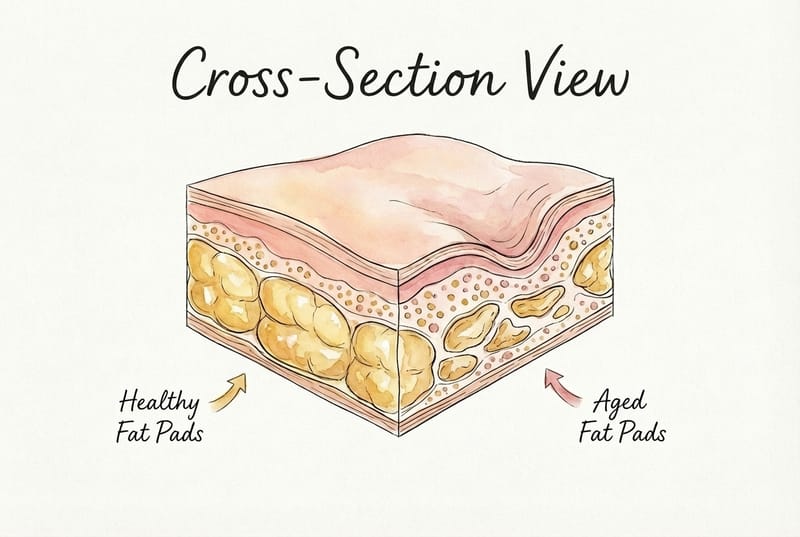
Volume loss is driven by the gradual reduction of fat pads beneath the skin, combined with decreased muscle tone and slower tissue renewal. Workouts that target the cheek and mid-face muscles help support structure from the inside, building tone that counteracts the hollow effect over time.
Type Three: Sagging Dominant
This type is defined by descent. The skin and soft tissue in the lower face, around the jaw, neck, and lower cheeks, has shifted position over time. Jowling, a softening of the jawline's definition, and a heavier appearance to the lower face are the clearest signs.
Sagging is influenced by reduced muscle tone, ligament laxity, and gravity's effect on tissue over time. Face yoga exercises that focus on the jaw, neck, and lower cheek muscles are particularly relevant for this type, working to lift and firm from the inside.
Type Four: Combination
Many people find that their face shows signs of more than one type, typically with one area dominated by fine lines and another by volume loss or sagging. This is the most common pattern. The upper face may behave like a Fine Lines Dominant type while the lower face shows sagging. Combination types benefit from a layered approach, addressing the most visually prominent concern first while supporting the others.
How Your Type Shapes Your Practice
Inside Yasmine, face yoga workouts are grouped by focus area and concern, which means your aging type can guide how you build your weekly practice. Fine Lines Dominant types get the most from brow-smoothing and forehead-releasing sequences. Volume Loss types benefit from cheek and mid-face sculpting. Sagging types see the strongest results from jaw, neck, and lower-face lifting routines. Combination types can rotate across all three, anchoring to the area of greatest concern.