Face Yoga
Understanding Your Facial Muscles
A simplified guide to the muscles beneath your skin: which groups do what, where they are, and which areas respond fastest to face yoga.
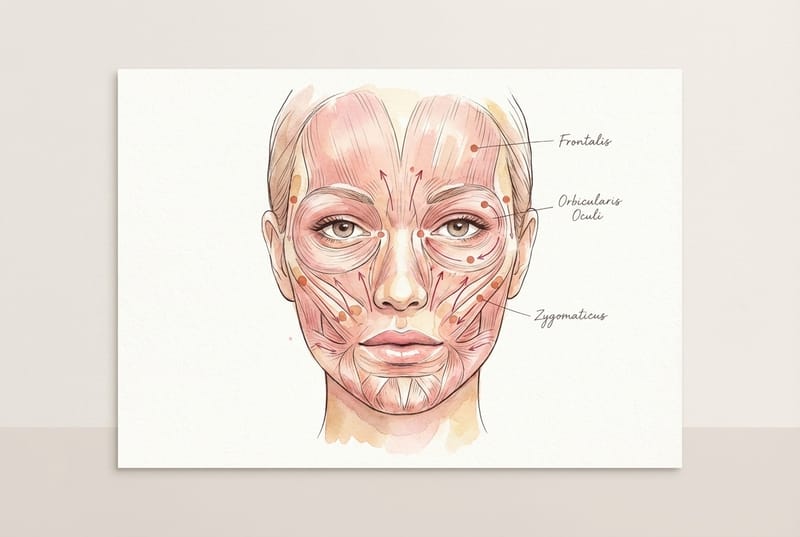
You do not need a degree in anatomy to practice face yoga effectively, but understanding the basics of your facial muscle structure transforms the practice from guesswork into targeted training. When you know which muscle you are working and what it does, every exercise becomes more intentional and more effective.
How Facial Muscles Are Different
Most muscles in your body attach to two bones and move a joint when they contract. Facial muscles are unusual because many of them attach to bone on one end and to skin on the other. This is why your facial muscles can create such fine, expressive movements: a slight contraction pulls the skin into a smile, a frown, a raised eyebrow. It is also why the condition of these muscles directly shapes the appearance of your face.
When facial muscles lose tone, the skin they support loses its underlying scaffold. When they carry chronic tension, they pull the skin into habitual patterns that eventually become lines and creases. Face yoga addresses both issues by strengthening weak muscles and releasing tight ones.
The Forehead Group
The frontalis muscle covers the entire forehead. It is responsible for raising your eyebrows and creating horizontal forehead lines. For most people, the frontalis is chronically overworked because it compensates for drooping eyelids and habitual expressions of surprise or concern. Face yoga helps by strengthening the muscle so it supports the brow without constant contraction, and by releasing the tension patterns that create deep lines.
The Eye Area
The orbicularis oculi is a ring-shaped muscle that encircles each eye. It controls blinking, squinting, and the crow's feet lines that radiate from the outer corners. This muscle weakens with age, contributing to hooding of the upper lid and hollowing beneath the eye. Targeted exercises improve its tone and help keep the eye area firm and open.
The corrugator muscles sit between the eyebrows and pull them together to create the vertical frown lines sometimes called the eleven lines. These are among the most tension-prone muscles in the face, and releasing them through face yoga can soften those lines noticeably within weeks.
The Cheek and Midface
The zygomaticus major and minor are the muscles that pull your mouth upward and outward into a smile. They run from the cheekbone down to the corners of the mouth. Strong zygomaticus muscles create the appearance of lifted, full cheeks. When these muscles weaken, the midface flattens and the nasolabial folds deepen. This area responds particularly fast to face yoga because the muscles are relatively large and well-positioned for targeted exercise.
The Mouth and Lip Area
The orbicularis oris is the circular muscle around the mouth, responsible for pursing the lips and controlling speech. Surrounding it are several smaller muscles that pull the lips in various directions. Vertical lip lines develop when the orbicularis oris loses tone or carries tension. Face yoga exercises for this area help maintain lip fullness and smooth the fine lines that form around the mouth over time.
The Jawline and Lower Face
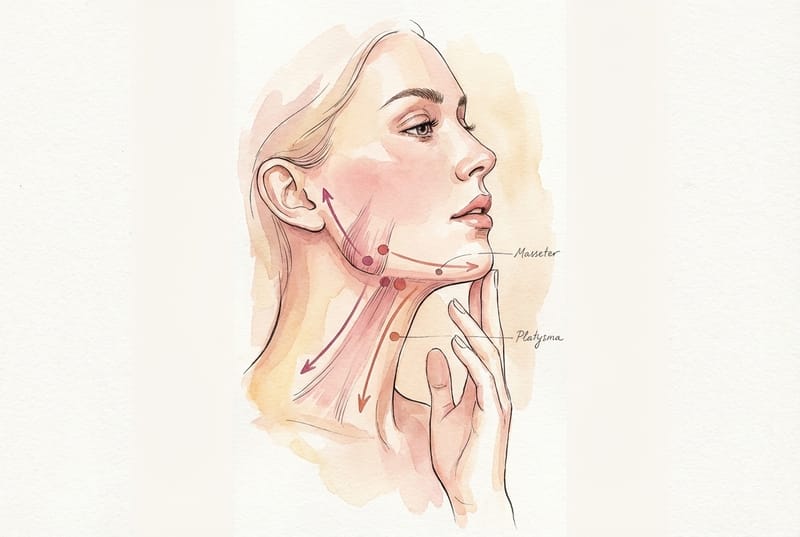
The masseter is the powerful chewing muscle that runs from the cheekbone to the lower jaw. It is often the tightest muscle in the face, especially for people who clench or grind their teeth. Releasing masseter tension is one of the most immediately rewarding aspects of face yoga, as it can relieve jaw pain, headaches, and the square or heavy appearance that chronic clenching creates.
The platysma is a broad, thin muscle that spans from the chest up through the neck to the lower jaw. When it weakens, the neck develops horizontal bands and the jawline loses definition. Strengthening the platysma is key to maintaining a clean jaw-to-neck transition.
Which Areas Respond Fastest
Not all facial muscles respond to exercise at the same speed. The cheeks and jawline typically show the earliest improvements because the muscles there are relatively large and easy to isolate. The eye area and forehead take slightly longer because the muscles are thinner and more intertwined. The neck and platysma require the most patience but produce some of the most dramatic results over time.
Yasmine organizes its face yoga sessions around these muscle groups, progressively targeting each area as your practice develops. Understanding the anatomy behind the exercises helps you feel the right muscles working and ensures every session counts.