Face Yoga
Tracking Progress and Staying Motivated
Practical strategies for documenting your face yoga results, recognizing progress, navigating plateaus, and building a habit that lasts.

Face yoga results are cumulative, which means the changes happen gradually enough that you can miss them entirely without a system for tracking. The face you see in the mirror every day shifts so slowly that your brain adjusts to each incremental change. A simple tracking habit makes the difference between feeling like nothing is happening and being able to see, clearly, how far you have come.
Why Photos Are Essential
Progress photos are the most reliable way to track face yoga results. Your perception of your own face is subjective and influenced by lighting, mood, hydration, and how much sleep you got. Photos taken under consistent conditions give you an objective record that you can compare over time.
- Choose a consistent setup. Same location, same lighting, same time of day. Morning, before applying products, in natural light near a window is ideal.
- Take three angles. Front-on, left profile, and right profile. These capture changes in different areas of the face that a single angle might miss.
- Photograph weekly. Weekly photos provide enough data to see trends without becoming obsessive. Set a recurring reminder so you do not forget.
What to Look For
When comparing photos, focus on structural changes rather than surface-level fluctuations. Skin can look better or worse on any given day due to hydration, sleep, and diet. The changes that face yoga produces are beneath the surface and show up as shifts in contour and definition.
- Cheek fullness and lift: compare the height of the cheekbone area and the depth of the nasolabial folds.
- Jawline definition: look at the sharpness of the jaw angle and the clarity of the jaw-to-neck transition.
- Eye area openness: notice whether the eyes look more open and the skin around them appears firmer.
- Overall facial symmetry: face yoga can gradually improve asymmetries by strengthening weaker muscles.
Navigating Plateaus
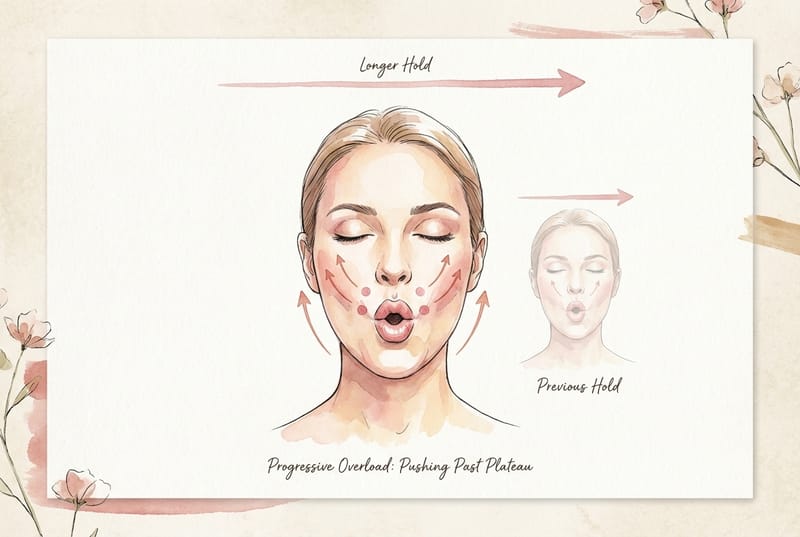
Every face yoga practitioner hits a plateau, a period where progress seems to stall despite consistent practice. Plateaus are normal and actually indicate that your muscles have adapted to their current workload, which means they are stronger than when you started.
The way through a plateau is progressive overload: slightly longer holds, an extra repetition, or a new exercise that challenges the muscles in a different way. Yasmine handles this progression automatically by adjusting your sessions as your practice matures, but being aware of the plateau phenomenon helps you stay patient when it occurs.
Building the Habit
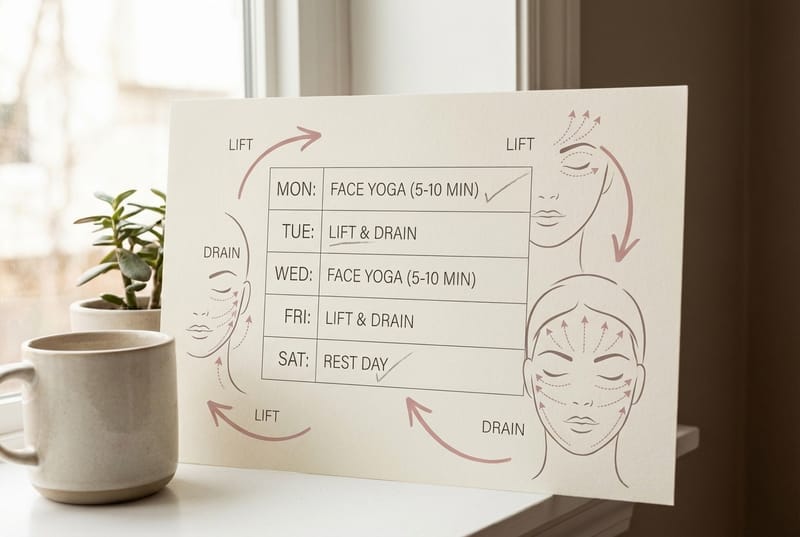
Motivation fluctuates. Habits persist. The goal is to make face yoga a habit that does not depend on how motivated you feel on any given day. The most effective strategy is to anchor your practice to an existing daily behavior.
- If you always wash your face in the morning, face yoga becomes the step immediately after.
- If you always have coffee at the same time, face yoga becomes the five minutes while the coffee brews.
- If you always wind down before bed, face yoga becomes part of that ritual.